English
Stainless steel access panels are the superior choice for environments that demand durability, hygiene, and long-term performance. Whether you're outfitting a commercial kitchen, a hospital corridor, a pharmaceutical facility, or an industrial plant, stainless steel consistently outperforms alternatives like plastic, drywall, or standard steel. The core reasons are simple: it resists corrosion, withstands heavy use, meets strict hygiene standards, and delivers a lower total cost of ownership over its lifespan.
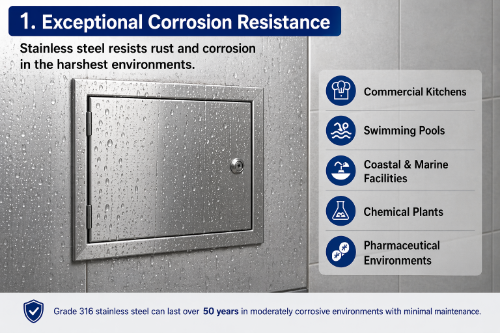
One of the most compelling reasons to choose a stainless steel access panel is its resistance to rust and corrosion. Standard steel panels begin to corrode within months when exposed to moisture, chemicals, or humidity. Stainless steel, by contrast, contains a minimum of 10.5% chromium, which forms a self-repairing passive oxide layer on the surface that continuously protects the metal.
In environments such as commercial kitchens, swimming pool mechanical rooms, or coastal buildings where salt air is prevalent, panels made from Grade 316 stainless steel offer even greater protection due to the addition of molybdenum. Studies have shown that Grade 316 stainless steel can last over 50 years in moderately corrosive environments with minimal maintenance.
Common environments where corrosion resistance is critical include:
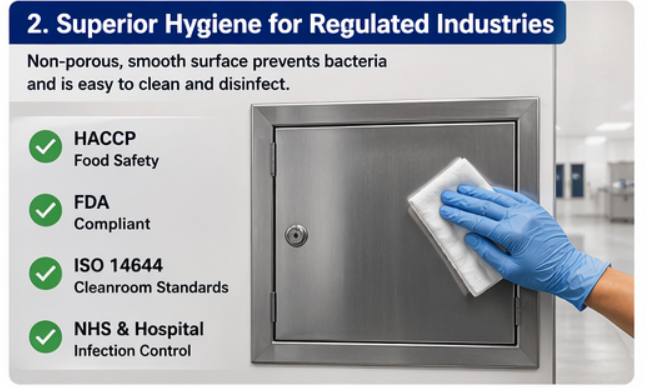
Hygiene is non-negotiable in healthcare, food processing, and pharmaceutical environments. Stainless steel access panels provide a non-porous, smooth surface that prevents bacteria, mold, and contaminants from embedding in the material. Unlike painted steel or plastic panels, stainless steel does not absorb moisture or harbor microbial growth.
This makes stainless steel access panels compliant with stringent standards such as:
Cleaning is equally straightforward. Stainless steel panels can be wiped down with harsh disinfectants, including bleach-based solutions, without degrading the surface. This is a critical advantage over plastic panels, which can crack or discolor when exposed to strong cleaning agents.
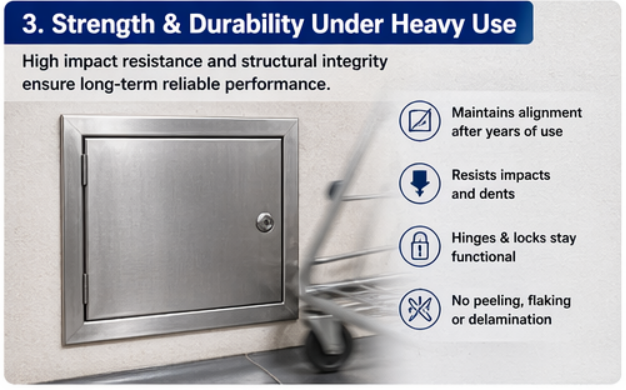
Access panels in high-traffic areas are subject to repeated opening, closing, impacts, and physical stress. Stainless steel panels are significantly more impact-resistant than plastic or standard drywall access panels. Austenitic stainless steel (the most common type used in panels) has a tensile strength of approximately 515–620 MPa, compared to around 150–300 MPa for mild steel and far less for polymer alternatives.
In practical terms, this means:
For facilities where access panels are opened and closed dozens of times per week — such as building maintenance corridors or utility rooms — this structural integrity translates directly into reduced repair and replacement costs.
To understand the full value of stainless steel access panels, it helps to compare them directly against the most common alternatives across key performance criteria.
| Corrosion Resistance | Excellent | Good | Poor | Good |
| Impact Resistance | Excellent | Fair | Good | Fair |
| Hygiene Rating | Excellent | Fair | Poor | Good |
| Lifespan | 50+ years | 10–15 years | 10–20 years | 20–30 years |
| Maintenance Required | Minimal | Low | High | Low |
| Upfront Cost | Higher | Low | Medium | Medium |
| Fire Resistance | High | Low | Medium | Medium |
A stainless steel access panel typically costs more upfront than its plastic or mild steel counterparts. However, when evaluated over a full facility lifecycle, the total cost of ownership tells a very different story. Consider the following breakdown for a mid-sized commercial facility replacing 20 access panels:
Over three decades, stainless steel panels can cost the same or less than alternatives that appear cheaper initially, especially when labor costs for painting, patching, and replacement are factored in. For facilities with dozens or hundreds of panels, the savings compound significantly.
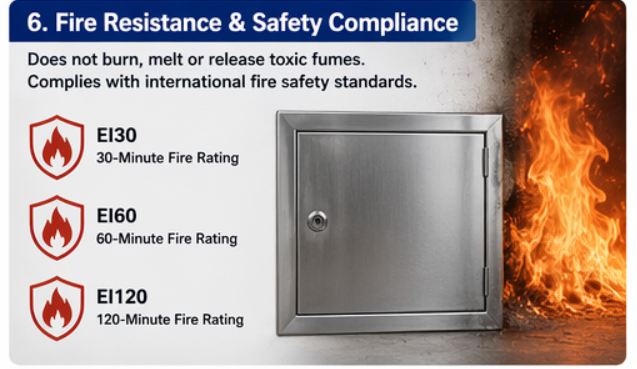
In buildings where fire safety is a regulatory requirement, access panel material choice directly affects compliance. Stainless steel does not ignite, burn, or release toxic fumes when exposed to fire — a critical advantage over plastic panels, which can melt, combust, and emit harmful gases. Stainless steel maintains structural integrity at temperatures up to 870°C (1,600°F) for standard grades, and even higher for specialty grades.
Fire-rated stainless steel access panels are available with verified ratings such as:
These ratings align with requirements under BS 476 (UK) and EN 1634 (Europe), making stainless steel panels a straightforward choice for fire-compliant installations.
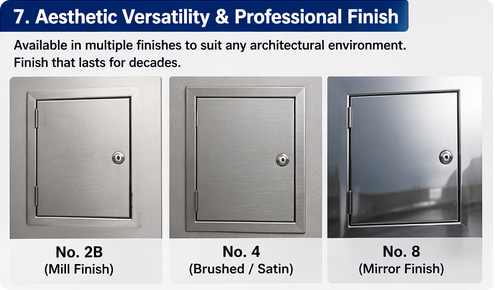
Beyond functional performance, stainless steel access panels contribute to a clean, professional appearance that suits a wide range of architectural environments. The material is available in several standard finishes:
Unlike painted steel, the finish on a stainless steel panel does not chip, peel, or fade over time. In high-visibility areas such as hotel lobbies, airport terminals, or upscale retail environments, this sustained aesthetic quality reduces the need for cosmetic maintenance.
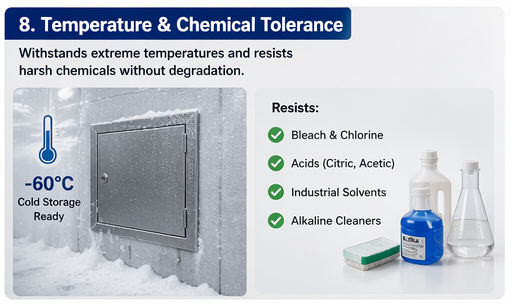
Some installations require access panels that can withstand extreme temperatures or regular contact with aggressive chemicals. Stainless steel excels in both scenarios. In cold storage and freezer rooms, where temperatures can drop to –60°C, stainless steel retains its mechanical properties without becoming brittle — a known failure mode for plastic panels in cryogenic environments.
On the chemical side, stainless steel resists:
This tolerance is particularly important in pharmaceutical manufacturing cleanrooms, where daily chemical sanitization is standard practice and panels must maintain their integrity without degrading the surrounding sterile environment.
While stainless steel is the best-performing option in many scenarios, it is most clearly the right choice when one or more of the following conditions apply:
For standard dry interior applications with light use and no hygiene requirements — such as a residential utility cupboard — a plastic or mild steel panel may suffice and represent better value. However, for any environment with demanding performance requirements, stainless steel is rarely the wrong choice, and frequently the only material that will perform reliably across the full life of the building.

Contact Us
SHUNSHI provides a range of technical support services to ensure that customers are able to properly select, install and maintain these products.
Products
Access Panels GuideContact
Tel: 86-15988108762
86-572-8298792
Fax: 86-572-8298792
E-mail: [email protected]
No.281 Mingzhu Main Road, Leidian Town, Deqing, Huzhou, Zhejiang, China, 313219

 English
 Español
 عربى
عربى