
English
 English
 Español
 عربى
عربى

Why Material Choice Is a Technical Decision, Not a Budget One
When specifying access panels for a construction or renovation project, the choice between steel and aluminum is one of the most common purchasing decisions a contractor or buyer faces — and one of the most frequently misunderstood.
Many buyers default to steel because it feels stronger, or choose aluminum because it sounds lighter and more modern. Both instincts are partially right, but neither tells the full story. The correct choice depends on the specific environment, fire rating requirements, installation conditions, and long-term maintenance expectations of your project.
At Zhejiang Shunshi Intelligent Technology Co., Ltd., we have manufactured steel and aluminum access panels since 2005. With over 16 registered patents, ISO 9001 certification, and products shipped to 91 countries, we see how buyers from different markets — North America, Europe, the Middle East, and Oceania — make these decisions every day. This guide documents what we have learned so you can make the right call for your specific application.
This article covers six technical dimensions: structural strength, corrosion resistance, fire rating capability, total cost of ownership, installation handling, and recommended application scenarios. For a broader overview of access panel materials, see our Access Panel Types & Materials guide.
Steel vs Aluminum: Side-by-Side at a Glance
The table below summarizes the six core comparison dimensions. Each is explained in full detail in the sections that follow.
| Comparison Dimension | Steel Access Panel | Aluminum Access Panel |
|---|---|---|
| Base Material | Cold-rolled steel (CRS) or galvanized steel | Aluminum alloy (typically 6061 or 6063) |
| Weight (typical 12"×12" unit) | Heavier (~1.8–2.5 kg) | Lighter (~0.8–1.2 kg) |
| Corrosion Resistance | Requires coating (powder coat, galvanizing) | Natural oxide layer; excellent bare resistance |
| Max Fire Rating Achievable | Up to 2-hour (UL10B / BS476 compliant) | Usually limited to 1-hour; higher is rare and costly |
| Unit Cost (general range) | Lower upfront cost | Moderately higher upfront cost |
| Ease of Ceiling Installation | Heavier; may require two-person install | Lightweight; one-person ceiling install feasible |
| Long-Term Maintenance | Coating may degrade; periodic inspection needed | Minimal; self-protecting surface |
| Best Environment | Dry commercial interiors, fire-rated assemblies | Humid, coastal, exposed, or aesthetic-priority spaces |
Dimension 1: Structural Strength and Weight
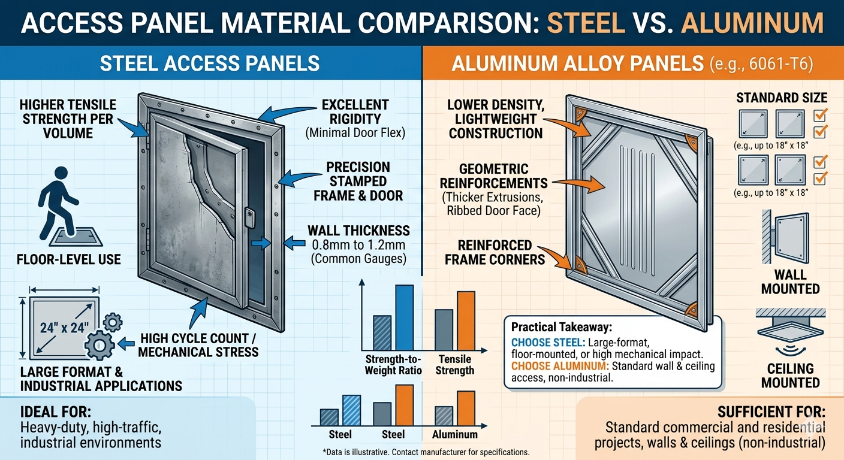
Steel has a higher tensile strength per unit volume than aluminum. For access panels, this matters most in applications involving frequent access (high cycle count) or mechanical stress — such as floor-level panels, panels in industrial facilities, or larger-format panels (24"×24" and above) where door flex under load is a concern.
Cold-rolled steel panels from Shunshi's manufacturing line undergo precision stamping and forming to achieve consistent wall thickness, typically 0.8mm to 1.2mm for standard commercial panels. At these gauges, steel maintains excellent rigidity without excessive weight.
Aluminum alloy panels (6061-T6 or 6063-T5), while inherently less dense, compensate through geometric design — thicker extrusions, ribbed door faces, and reinforced frame corners. For panel sizes up to 18"×18", a well-engineered aluminum panel provides sufficient structural performance for wall and ceiling applications in non-industrial settings.
Practical takeaway: Choose steel when the panel is large-format, floor-mounted, or subject to mechanical impact. Aluminum is adequate for standard wall and ceiling access in commercial and residential projects.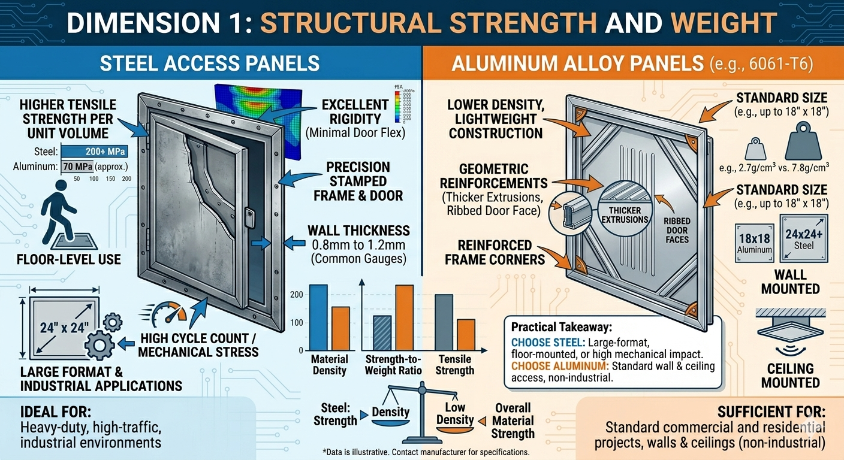
Dimension 2: Corrosion Resistance
This is the single area where aluminum has a clear, unconditional advantage. Aluminum naturally forms a stable aluminum oxide layer when exposed to air. This self-repairing oxide layer protects the base metal from further oxidation without any external treatment — which is why aluminum is commonly used in coastal construction, food processing environments, and anywhere moisture or chemical exposure is expected.
Steel, by contrast, requires active corrosion protection. Galvanized steel (zinc-coated) provides moderate protection — typically rated for interior use. Powder-coated steel extends this further, but any chip, cut, or scratch in the coating creates a corrosion initiation point. In high-humidity environments, unsealed steel panels can show rust within 12–18 months.
At Shunshi, our steel access panels receive a minimum of zinc phosphate pretreatment followed by epoxy powder coating (60–80 microns), which provides durable indoor protection. For genuinely corrosive environments, however, our recommendation is aluminum — not better-coated steel.
Practical takeaway: Humid rooms, coastal buildings, food service kitchens, exterior-adjacent walls, and anywhere cleaning chemicals are used — specify aluminum. Dry conditioned interiors — steel is fine and more cost-effective.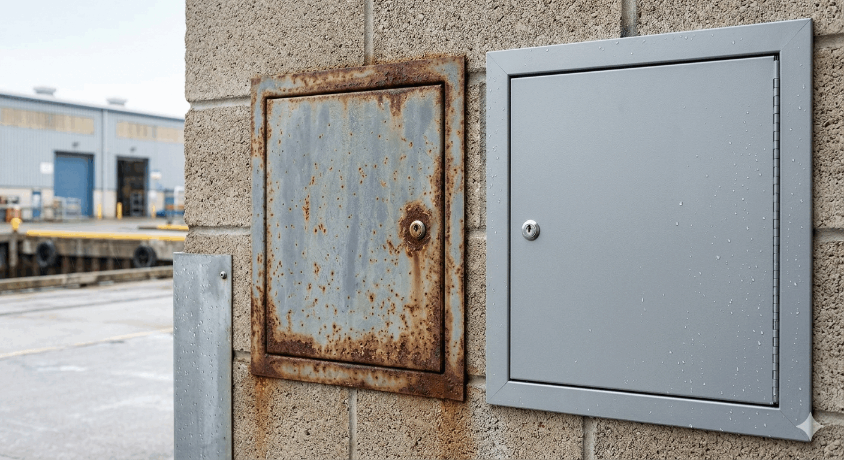
Dimension 3: Fire Rating Capability
This is an area of frequent confusion among buyers. The question is not whether a material is combustible — it is whether the complete panel assembly (door, frame, hinge, latch, and intumescent seals) has been tested and certified as a system that maintains fire compartmentalization when installed in a rated wall or ceiling.
Steel panels are significantly easier to engineer to high fire ratings because steel itself has a high melting point (~1370°C) and can be combined with intumescent strips and mineral wool insulation to achieve 60-, 90-, and 120-minute ratings under ASTM E119, UL10B, or EN 1634 standards. Shunshi's steel fire-rated panels carry independent certification for use in 2-hour rated assemblies — a common requirement in commercial buildings, hospitals, and multi-family residential construction.
Aluminum melts at approximately 660°C. This does not automatically disqualify aluminum from fire-rated use, but it means the engineering challenge is greater. Aluminum fire-rated panels do exist and are certified for 30- and 60-minute ratings in specific assemblies, but they require more complex intumescent protection and are considerably more expensive than their steel equivalents. For anything above 60 minutes, steel is the standard market solution.
Practical takeaway: If your project spec calls for any fire rating, default to steel unless you have a specific reason to use aluminum (usually weight or corrosion) and are prepared for higher cost and limited supplier options. Always verify the certification number on the panel label before installation — the label, not the material, is what code compliance is based on.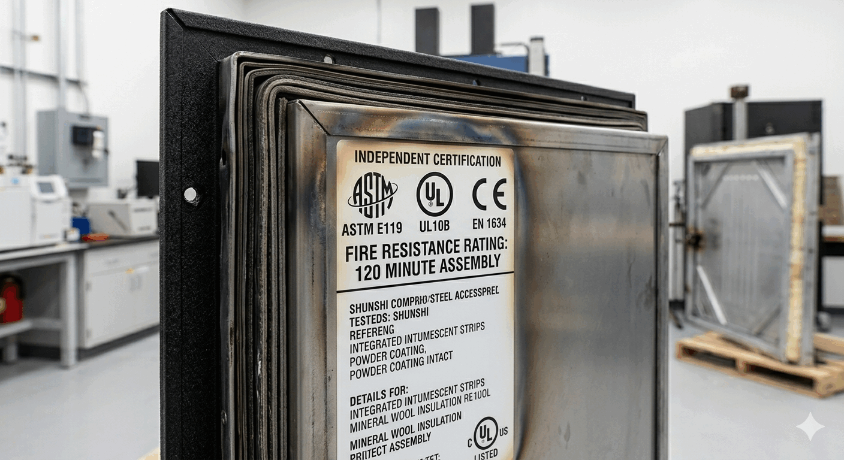
Dimension 4: Total Cost of Ownership
Upfront unit pricing for standard steel access panels is generally 15–30% lower than comparable aluminum panels, driven by lower raw material cost and simpler production.
However, total cost of ownership over a 10–15 year building lifecycle tells a more nuanced story:
- Steel panels in humid environments may require repainting or replacement within 5–8 years if coating degrades.
- Aluminum panels in the same environment typically require no maintenance intervention for 15+ years.
- Labor cost for ceiling installation is reduced with aluminum due to weight — relevant when installing multiple panels in a large project.
For large commercial projects in stable indoor environments, steel panels offer the best cost-efficiency. For projects in challenging environments or where maintenance access will be difficult (e.g., panels above finished ceilings in occupied buildings), the lower lifetime cost of aluminum may justify the higher purchase price.
Practical takeaway: Run a simple lifecycle cost calculation. If environment is benign and access is easy, steel wins on cost. If environment is harsh or maintenance is expensive, aluminum's total cost is often lower.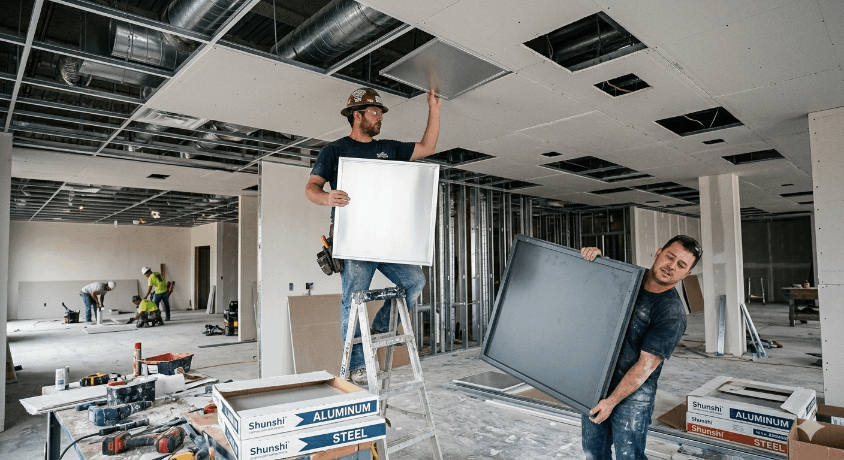
Dimension 5: Installation and Handling
Weight affects installation speed, labor requirements, and safety — especially for overhead ceiling installations. A standard 14"×14" steel access panel weighs approximately 2.0–2.5 kg. While manageable, repeated overhead lifting of steel panels in large projects accumulates fatigue and increases drop-risk.
An equivalent aluminum panel typically weighs 0.8–1.2 kg. This difference makes single-person ceiling installation feasible and reduces overall installation time. For contractors running multiple crews on large-scale commercial fit-outs, this translates directly to labor cost savings.
Both materials accept standard installation methods: drywall bead frame mounting, surface mounting, and stud-to-stud framing. Aluminum panels with anodized or painted finishes accept touch-up paint normally. Steel panels with powder coating require color-matched paint for any touch-up work — a minor but real consideration for exposed installations.
Practical takeaway: For ceiling installations or large-volume projects, aluminum reduces installation labor. For wall installations or smaller projects, steel's weight is not a significant factor.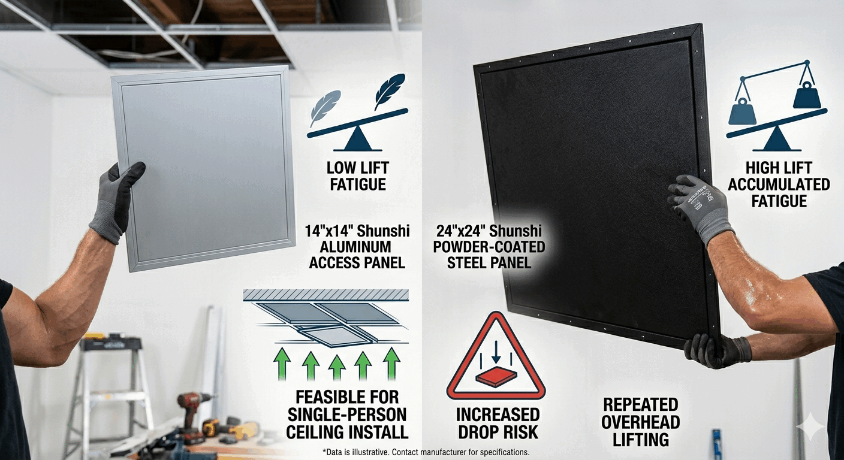
Dimension 6: Recommended Application Scenarios
Based on the five dimensions above, here is a practical application guide:
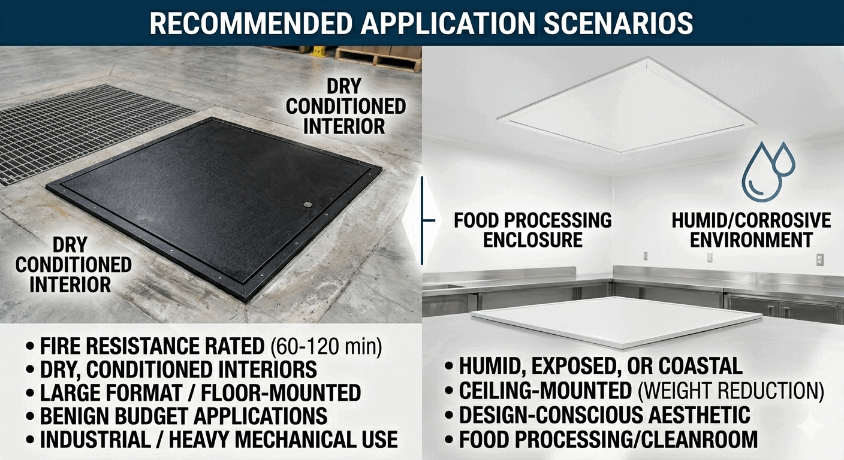
Choose steel access panels when:
- The wall or ceiling assembly has a fire resistance rating requirement (60, 90, or 120 minutes)
- The location is a dry, conditioned interior (offices, corridors, retail, hotel back-of-house)
- The panel is large-format (20"×20" or above) or floor-mounted
- Budget is a primary constraint and environment is benign
- The application is industrial with heavy mechanical use
Choose aluminum access panels when:
- The location is humid, exposed, or coastal (bathrooms, plant rooms, swimming pool enclosures, marine facilities)
- The panel is ceiling-mounted and weight reduction simplifies installation
- The project has a design-conscious aesthetic requirement (anodized aluminum, visible frame, architectural finish)
- The panel will be installed in food processing, pharmaceutical, or cleanroom environments where bare metal hygiene is required
- A 30- or 60-minute fire rating is acceptable and other project conditions favor aluminum
Making the Right Specification Decision
Steel and aluminum access panels serve the same fundamental function — providing reliable, repeatable access to concealed building systems — but they do so in meaningfully different ways that matter under real project conditions.
Steel is the right choice when fire rating compliance, structural rigidity, or cost-efficiency in dry environments are the primary drivers. Aluminum is the right choice when corrosion resistance, weight reduction, long-term maintenance minimization, or aesthetic finish quality takes priority.
The worst outcome is specifying the wrong material because of a simplified assumption — "steel is stronger" or "aluminum is better" — without accounting for the actual installation environment and regulatory requirements of the project.
At Zhejiang Shunshi Intelligent Technology Co., Ltd., we manufacture both steel and aluminum access panels across our standard and OEM product lines. Our engineering team provides material selection consultation for architects, specifiers, and contractors working on projects of all scales. All panels are manufactured under ISO 9001 quality management standards, with certifications available for fire-rated assemblies as required by your local code.
For a broader understanding of access panel materials and types, visit our Access Panel Types & Materials page, or return to the complete Access Panels Buying Guide.
To request samples, technical specifications, or a project quote, contact our team.